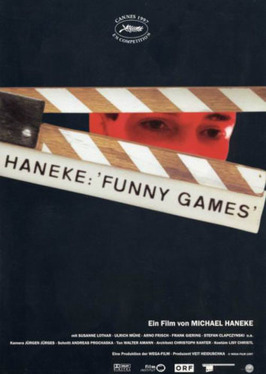
The Chilling Truth Behind Funny Games (1997) Fourth Wall Breaks
Michael Haneke's 1997 horror-thriller, Funny Games, is not merely a film about violence; it's a stark, unblinking mirror held up to its audience, forcing a profound examination of their own relationship with brutality as entertainment. Far from a conventional genre piece, Funny Games 1997 deploys audacious fourth-wall breaks that shatter cinematic conventions and challenge viewers to confront their complicity in the spectacle of suffering. It's a cinematic experience designed not to entertain, but to provoke, unsettle, and ultimately, indict.
In an era where violence in media can often feel desensitized, Haneke's masterwork deliberately avoids gratuitous gore, instead relying on psychological torture and the audience's imagination to craft a far more insidious horror. The film asks us, in no uncertain terms: What is our role when we consume violence, and what does that say about us?
Unmasking the Spectator: The Premise of Funny Games 1997
The setup for Funny Games 1997 begins innocently enough, almost deceptively so. We are introduced to a seemingly perfect, affluent family—Georg, Anna, and their son, Georgie—driving to their idyllic lakeside vacation home. The car radio serenades them with classical opera, a symbol of domestic tranquility. This peace is abruptly shattered by a brutal thrash metal track, a jarring auditory assault that immediately signals the descent into chaos that is to come. This initial juxtaposition brilliantly sets the stage for the film's central conflict: the collision of civilized life with unbridled, senseless cruelty.
Soon after their arrival, two polite, well-dressed young men, Peter (Frank Giering) and Paul (Arno Frisch), appear at their door, asking to borrow a few eggs. Sporting pristine white gloves and unsettlingly fake smiles, their attempts at politeness quickly devolve into thinly veiled disdain and aggression. What begins as a minor inconvenience escalates into a nightmarish ordeal, as the duo takes the family hostage, subjecting them to a series of sadistic "games" involving physical and mental torture. Haneke expertly crafts an atmosphere of dread and helplessness, not just for the characters on screen, but for the audience watching. Every polite gesture, every seemingly innocent request from the antagonists, is laced with a chilling undercurrent of menace, keeping viewers on edge and acutely aware of the horror unfolding.
The Breaking Point: Haneke's Fourth Wall Masterclass
What truly distinguishes Funny Games 1997 from other home invasion thrillers is its bold, unapologetic assault on the fourth wall. A "fourth wall break" occurs when a character directly addresses the audience, acknowledging the fictional nature of their world. Haneke uses this technique not as a playful nod, but as a weapon, transforming passive viewers into active, uncomfortable participants in the unfolding tragedy.
From the early stages of their terrifying "games," Paul frequently turns to the camera, winking, smirking, or even engaging in short, direct conversations with the audience. These moments are designed to implicate us, asking if we are enjoying the spectacle, if we are complicit in desiring the very violence the film purports to critique. It's an uncomfortable, unnerving experience that strips away the safe distance usually afforded to a film audience.
The most iconic and unsettling fourth-wall break arrives during a moment of profound hope for the terrorized family. After a desperate struggle, Anna manages to seize a shotgun and kill Peter. For a fleeting moment, relief washes over the audience, a conventional catharsis we've been conditioned to expect. However, Paul immediately grabs the remote control, literally rewinding the film a few seconds, undoing Peter's death. With a smug grin, he prevents the family's brief triumph, reasserting control over the narrative and, by extension, over the audience's expectations. This act is not just shocking; it's a deliberate, meta-cinematic refusal to provide the conventional satisfactions of the genre, denying the viewer the comfort of heroic retribution.
Haneke's intention is clear: he wants to expose how audiences are desensitized by formulaic violence and the predictable arcs of hero and villain. By pulling back the curtain on the cinematic illusion, he forces viewers to question their own desires for resolution, for revenge, and for the predictable narrative outcomes that often trivialize suffering. It’s a powerful, almost confrontational act of filmmaking that directly challenges the viewer's moral position.
Beyond Gore: The Philosophy of Violence in Funny Games (1997)
While Funny Games (1997) is undeniably brutal, its genius lies in what it doesn't show. Unlike many films influenced by the low-budget 70s slasher flicks like The Last House on the Left or I Spit on Your Grave, which often revelled in explicit gore, Haneke's approach is far more cerebral and insidious. Most of the actual physical violence and killings occur off-screen. We hear the sounds, we see the aftermath, but the direct act is often obscured. This artistic choice is central to Haneke's philosophical argument.
In the film’s production notes, Haneke famously stated: "The problem is not ‘How do I show violence?’ but ‘How do I show the viewer his own position in relation to violence and its portrayal?’" He believed that the "domestication" of violence through incessant on-screen brutality had left viewers desensitized, immune to its true horror. By refusing to show the explicit acts, Haneke compels the audience to fill in the blanks, to conjure the images in their own minds. This forces a more active, and thus more disturbing, engagement with the horror. The violence becomes more potent precisely because it is imagined, making the viewer a co-creator of the horror rather than a passive observer.
The "games" themselves are a masterclass in psychological torture, designed to break the family's spirit and dignity rather than just their bodies. From forced nudity to cruel bets on who will survive, these acts are meant to strip away humanity, making the audience profoundly uncomfortable with the casual sadism on display. This method of challenging the audience remains a defining aspect of the film's lasting impact.
Why Funny Games 1997 Still Resonates: A Timeless Challenge
More than two decades after its release, Funny Games 1997 remains as potent and unsettling as ever. Its critical examination of violence, media consumption, and audience complicity is perhaps even more relevant in our current media landscape, saturated with true crime documentaries, sensationalized news, and endless fictional depictions of brutality. The questions Haneke poses about desensitization and the ethics of spectatorship continue to echo loudly.
The film is not easy to watch, and it was never intended to be. It strips away the comforting distance of traditional cinema, forcing viewers into an uncomfortable confrontation with their own desires and expectations regarding violence on screen. For anyone seeking a deeper understanding of cinema's power to provoke and challenge, Funny Games 1997 offers an unparalleled lesson. It's a film that demands reflection, not just passive consumption.
Practical Tip: When approaching Funny Games 1997, it's crucial to understand that it is not meant to be "enjoyed" in the conventional sense of a horror film. Instead, view it as an intellectual exercise, a meta-commentary on the genre itself. Be prepared for discomfort, and allow yourself to engage with the uncomfortable questions it raises about your own position as a spectator.
In conclusion, Michael Haneke's Funny Games (1997) is a masterpiece of meta-horror, brilliantly utilizing fourth-wall breaks to dismantle the conventional viewer-film relationship. It’s a chilling reminder that the most profound horrors are often those that force us to look inward, confronting our own roles in the consumption and normalization of violence. By denying us catharsis, implicating us in the "games," and forcing us to fill in the blanks of its brutality, Haneke ensures that the unsettling truth of Funny Games 1997 lingers long after the credits roll, a testament to its enduring power and its audacious cinematic courage.