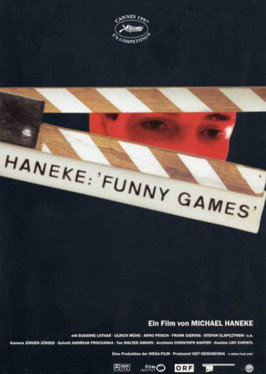
Funny Games (1997): Why This Horror Thriller Still Challenges Audiences
More than two decades after its initial release, Michael Haneke’s harrowing horror-thriller,
Funny Games (1997), remains a stark and unsettling cinematic experience that continues to provoke, disturb, and challenge audiences worldwide. This isn't just another slasher flick; it's a meticulously crafted meta-commentary on the consumption of violence in media, sadistically turning the lens back on the viewer and forcing uncomfortable self-reflection. If you've ever questioned your fascination with on-screen brutality, *Funny Games 1997* will undoubtedly amplify those doubts.
The Premise: Innocence Interrupted and Games Unleashed
The film opens with a seemingly idyllic scene: a well-to-do family – Georg, Anna, their son Georgie, and their dog Rolf – driving to their picturesque lakeside vacation home on a beautiful summer day. The car stereo plays pleasant, calming classical music, painting a picture of domestic bliss. This tranquility is abruptly shattered by a jarring cut to brutal thrash metal, a not-so-subtle sonic foreshadowing of the darkness to come. This immediate juxtaposition of good versus evil, light versus dark, is the thematic cornerstone upon which the entire narrative of
Funny Games (1997) is built.
Soon after settling in, two impeccably dressed young men, Peter (Frank Giering) and Paul (Arno Frisch), arrive at their door. Sporting pristine white gloves and disarming, almost unsettlingly polite smiles, they introduce themselves as friends of the neighbors and ask to borrow some eggs. From the outset, their politeness feels less like genuine cordiality and more like a thinly-veiled veil for something sinister. Their attempts at civility are laced with an undercurrent of disdain, immediately casting an unsettling feeling over the family and, by extension, the audience.
What begins as a bizarre, uncomfortable request quickly escalates into a nightmarish ordeal. The family is taken prisoner in their own home, subjected to a series of ruthless "games" orchestrated by Peter and Paul. These aren't innocent parlor games; they are elaborate forms of physical and psychological torture, designed to break the family's spirit and will. Haneke masterfully creates tension not through explicit gore, but through the chilling anticipation of violence, the psychological torment, and the sheer audacity of the tormentors. Every moment is a test of endurance, a harrowing exploration of human vulnerability and the banality of evil.
Haneke's Masterclass in Meta-Commentary and Audience Complicity
Michael Haneke, renowned for his penetrating and often confrontational filmmaking style in works like *Caché* and *The Piano Teacher*, utilizes
Funny Games 1997 not merely to depict violence, but to critically dissect the audience's relationship with it. His intent is not to entertain with horror tropes, but to expose the voyeuristic pleasure often derived from cinematic brutality. As Haneke himself stated in the film's production notes: "The problem is not ‘How do I show violence?’ but ‘How do I show the viewer his own position in relation to violence and its portrayal?’"
This philosophy is most powerfully expressed through the film's infamous fourth-wall breaks. Paul, the more articulate and seemingly in-charge of the two antagonists, frequently glances directly at the camera, addressing the audience with knowing smiles and chilling provocations. These moments are not just stylistic flourishes; they are direct challenges, implicating the viewer in the unfolding terror. We become unwilling accomplices, forced to confront our own role as passive observers of suffering.
Perhaps the most audacious example of this meta-commentary occurs during a moment of potential hope for the family. When a character manages to briefly gain the upper hand, Paul simply grabs a remote control, rewinds the sequence of events, and manipulates the outcome to a much more grim and hopeless conclusion. This act is a brutal slap in the face to traditional narrative expectations, playfully – yet sadistically – giving hope to the audience only to snatch it away, reminding us that we are merely subjects of Haneke's experiment. For a deeper dive into this unique aspect of the film, consider reading
The Chilling Truth Behind Funny Games (1997) Fourth Wall Breaks.
Haneke believed that the "domestication" of violence through incessant portrayal in film and television has led to a desensitization among viewers.
Funny Games (1997) serves as a brutal counter-argument to this desensitization, using psychological rather than gratuitous visual horror to shock audiences back into awareness. It forces us to question our appetite for violence, our expectations of catharsis, and the comfort we often find in fictional suffering. For more on Haneke's broader themes, explore
Funny Games 1997: Haneke's Disturbing Look at Violence and Viewers.
Why Funny Games 1997 Still Resonates Today
The enduring power of
Funny Games 1997 lies in its timeless critique of media consumption and human nature. In an era saturated with true-crime documentaries, reality TV dramas, and an endless stream of explicit content readily available, Haneke's film feels more relevant than ever. It's a mirror reflecting our own society's morbid curiosity and the ease with which we consume narratives of suffering from a safe distance.
Drawing Parallels: 70s Slasher Influence and Modern Horror
While
Funny Games (1997) shares some superficial DNA with low-budget 1970s slasher classics like *The Last House on The Left* and *I Spit on Your Grave* – films that also dared to shove violence down the audience's throat for introspective purposes – Haneke's approach is distinct. These earlier films, while shocking, often reveled in the exploitation to make their point. Haneke, however, strips away any pretense of entertainment, instead focusing on the psychological erosion of his victims and the discomfort of the observer. There are very few explicit acts of violence shown on screen; instead, the camera often cuts away, leaving the horrific implications to the viewer's imagination, a far more potent form of terror. This strategic withholding of gore amplifies the psychological dread, making the unseen far more terrifying than anything explicitly depicted.
Practical Takeaways: Becoming a More Critical Viewer
Engaging with a film like
Funny Games (1997) can be more than just a disturbing experience; it can be an educational one, prompting a deeper critical engagement with all media. Here are some actionable insights:
- Question Your Engagement: When watching any violent content, consider *why* you're drawn to it. Is it genuine interest in the story, or a morbid curiosity that aligns with Haneke's critique?
- Analyze the Director's Intent: Not all depictions of violence are created equal. Is the director glorifying it, or using it as a tool for social commentary, as Haneke does?
- Look Beyond the Surface: Great horror, like *Funny Games 1997*, often uses its genre trappings to explore deeper philosophical or societal issues. What subtext is being conveyed?
- Reflect Post-Viewing: Don't just turn off the TV and forget. Allow controversial films to challenge your perspectives and spark internal dialogue.
Conclusion
Funny Games (1997) is not a film designed for comfort or easy entertainment. It is a calculated, chilling experiment in audience manipulation, a brutal deconstruction of the horror genre, and a profound commentary on our societal desensitization to violence. Michael Haneke’s genius lies in his ability to make the viewer acutely aware of their own position, transforming them from passive spectator to implicated participant. For those willing to confront its unsettling truths, *Funny Games 1997* remains an essential and unforgettable cinematic experience, continuously challenging audiences to re-evaluate what they watch and why.